Laboratory Testing
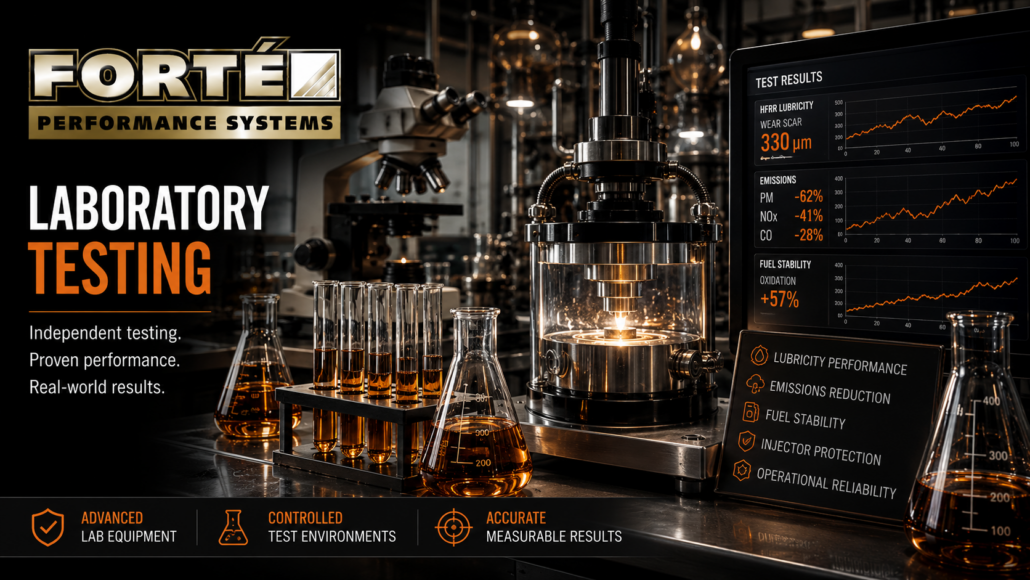
Independent laboratory testing validates lubricity improvement, combustion performance, emissions reduction, fuel stability, and operational reliability.
Testing Focus Areas
- Lubricity Performance
- Wear Reduction
- Fuel Stability
- Combustion Efficiency
- Emissions Analysis
- Injector Protection
Validated Testing Programs
Forté laboratory testing focuses on measurable improvements in fuel system protection, combustion quality, emissions output, and operational efficiency.
HFRR Lubricity Testing
Evaluates fuel lubricity performance and wear scar reduction under controlled testing conditions.
Injector Deposit Testing
Measures injector cleanliness, deposit prevention, and combustion consistency.
Emissions Evaluation
Analyzes particulate matter, smoke reduction, NOx output, and combustion efficiency.
Fuel Stability Analysis
Measures oxidation stability, contamination resistance, and storage performance.
The HIGH FREQUENCY RECIPROCATING RIG TEST (HFRR) is a microprocessor-controlled reciprocating friction and wear test system which provides a repeatable assessment of the performance of fuels and lubricants.
The test measures the lubricity, the ability of the fluid to affect friction between moving parts.
In June 2008, several diesel performance products and Forté Premium ULS Diesel Booster ® were tested at their prescribed treat ratios. The following competitors, in no particular order, were tested – Gunk Diesel Max, DSG 4Plus Premium, DSG 4Plus Arctic, Motomaster Diesel Treatment, Prestone Diesel Treatment, Howes Diesel Conditioner and Kleen Flo Diesel Conditioner.
A ULSD baseline was also tested and the following results were produced (results were averaged over 2 runs).

Summary:
Forté Premium ULS Diesel Booster® delivered the best overall lubricity performance in the HFRR comparison testing while maintaining a competitive treatment cost per litre.